Volkskundemuseum Wien
Otto Wagner Areal, Pavillon 1
Baumgartner Höhe 1, 1140 Wien
Öffnungszeiten:
Di-Fr: 10-17 Uhr
Anfahrt
Postanschrift:
Laudongasse 15-19, 1080 Wien
T: +43 1 406 89 05
F: +43 1 406 89 05.88
E: office@volkskundemuseum.at
Zum Newsletter:
HIER anmelden &
informiert bleiben!
Mostothek @ OWA
Mai-Sep: Dienstags, 17 Uhr
Dafür soll Wissen aus der musealen, aktivistischen und kulturpolitischen Praxis gesammelt und geteilt werden. In unserem dreitägigen Programm stellen wir Erfahrungen aus der Praxis von migrationszentrierten Museen von London über Belgrad bis Montevideo vor, beleuchten ausgewählte Themen österreichischer migrantischer Geschichte und diskutieren mit migrantischen Initiativen sowie allen Interessierten vor Ort. Vor allem möchte diese Veranstaltung die Vielfalt migrantischer Musealisierung aufzeigen und die Resilienz migrantischer Geschichte(n) feiern.
Das Lab wird in 5 thematische Sektionen aufgeteilt sein:
- Sektion ‚Utopia‘ (wir imaginieren die Zukunft von MUSMIG)
- Sektion ‚Space‘ (welchen Raum braucht ein Museum der Migration)
- Sektion ‚Allies‘ (welche Verbündete braucht ein Museum der Migration)
- Sektion ‚Visibility/Campaigning‘ (wie kann ein Museum der Migration sichtbar sein/bleiben)
- Sektion ‚Politics/Decolonizing‘ (hier soll es um Diskussion der politisch-diskursiven Funktion von Museen der Migration gehen)
In jeder der Sektionen soll mindestens ein Expert:innenvortrag von unseren Gästen aus den anderen Museen und ein Workshop stattfinden. Außerdem wird es ein größeres World Café geben, zu dem wir Initiativen aus Wien einladen und interessiertes Publikum, das wir für einen verstärkte Vernetzung in Wien und darüber hinaus nutzen wollen.
Eine detaillierte Liste der Vorträge, Workshops, künstlerischen Interventionen und Performances wird ab September zur Verfügung stehen.
14:00 - 14:30
Eröffnung
14:30 - 15:15
Sektion ‚Politics/Decolonizing‘
Vortrag: Selbstbestimmte Historisierung von Migration. Geschichte einer Forderung in Österreich
Speaker: Ljubomir Bratić, Anna Seidel
-> Ohne Anmeldung
Seit 2019 fordert MUSMIG ein Museum der Migration in Österreich – ein Museum, das Migrationsgeschichte(n) sammelt, archiviert, ausstellt und vermittelt, im Austausch mit den migrantischen Communitys selbst. Ein Museum nicht (nur) über Migrant:innen, sondern eines, das Geschichte aus dem Blickwinkel von migrantischen Individuen erzählt. Der Kampf um eine selbstbestimmte, institutionalisierte Historisierung von Migration beginnt aber nicht erst mit MUSMIG. Ljubomir Bratić und Anna Seidel (beide Mitglieder des MUSMIG Kollektivs) geben einen Überblick über die Geschichte und Folgen jener Forderung, die sich in Form von Kampagnen, Ausstellungen und anderen aktivistischen Formaten bis heute manifestiert hat und Nährboden wie Kontext für MUSMIGs Arbeit bildet.
-EN-
Self-Determined Historicization of Migration: The History of a Demand in Austria
Since 2019, MUSMIG has been calling for a museum of migration in Austria – a museum that collects, archives, exhibits and narrates migration histories in exchange with migrant communities themselves. A museum not (only) about migrants, but one that narrates history from the perspective of migrant individuals. The struggle for a self-determined, institutionalized historicization of migration, however, does not begin with MUSMIG. Ljubomir Bratić and Anna Seidel (both members of the MUSMIG collective) give an overview of the history and the effects of that demand, which has manifested in campaigns, exhibitions and other activist formats up to the present day and which forms both the fertile ground and the context for MUSMIG's work.
15:15 - 15:30 Pause
15:30 - 16:15
Sektion ‚Space‘
Führung mit Natalie Deewan: "Das Museum der Migration wird manifest ... und platzt aus allen Nähten"
Wo: MUSMIG-RAUM
-> Ohne Anmeldung
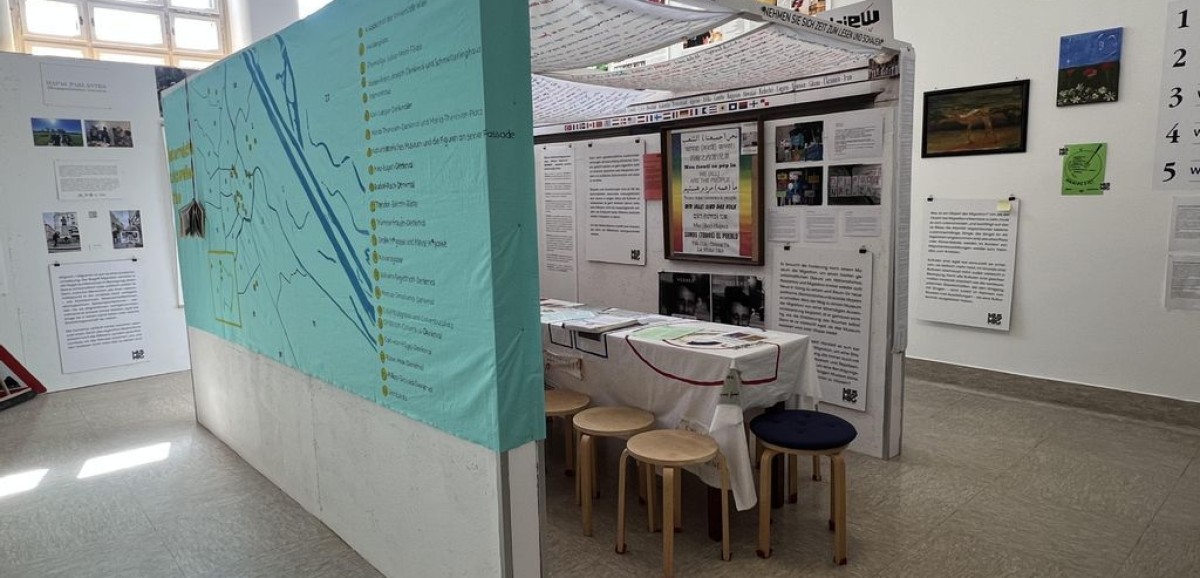
Auf den 38 m2 unseres temporären MUSMIG-Raums manifestiert sich u.a. das ganz Private (z.B. Bescheide) und das ganz Öffentliche (z.B. Plakate), div. Formen der Selbstgeschichtsschreibung überlagern einander und dazwischen: ganz viel Text, ganz viele Fragen ...
-EN-
In the 38 m2 of our temporary MUSMIG room the very private (e.g. documents) and the very public (e.g. posters) overlap with different forms of self-historicization among a lot of text and many questions ...
16:15 - 16:30 Pause
16:30 - 17:15
Sektion ‚Politics/Decolonizing‘
Vortrag: Can the Migrant Speak – About Anything Else?
Speaker: Lina Falivena (Museum Selma/DOMID e.V.)
-> Ohne Anmeldung
What becomes visible when perspectives shaped by experiences of migration are understood not simply as perspectives on migration, but as perspectives on society as a whole? This challenges a common expectation: that people who have migrated—or whose lives are shaped by migration—should primarily speak about migration, displacement, integration, identity, or belonging, and that museums about migration should primarily tell these kinds of stories. But what if experiences of migration are not a subject that determines what people speak about, but one perspective through which society itself can be explored?
This means resisting the tendency to essentialize migration or to construct a separate sphere of “migrant life.” Stories shaped by migration are not necessarily stories about migration. They can be stories about work and class, family and intimacy, politics and participation, housing and urban life, culture, conflict, and the everyday making of Germany. Migration can be a perspective on these subjects without becoming their defining framework.
Since the 1990s, a migrant self-organization has brought together a collection of shared stories, memories, and experiences, told from below and by the people themselves: DOMiD (Documentation Centre and Museum of Migration in Germany). Today, DOMiD is taking the next step by building Museum Selma, a new museum in Cologne dedicated to migration and the history of a diverse Germany.
The talk explores how DOMiD’s history and practice can inform the narrative of Museum Selma—one that seeks to inscribe stories shaped by migration into German history without turning them into a separate category of “migration history.” Building Museum Selma therefore becomes an opportunity to rethink not only how museums represent migration, but how they understand the people whose histories they collect—and how German society and history itself are narrated.
17:15 - 17:30 Pause
!!CANCELLED!!
Unfortunately, the talk with Karolina Grabowicz-Matyjas has been canceled due to personal reasons.
Sektion ‚Politics/Decolonizing‘
Vortrag: How to tell a story that's still unfolding? The Emigration Museum in Gdynia— open to a change.
Speaker: Karolina Grabowicz-Matyjas (Gdynia)
-> Ohne Anmeldung
Building any museum is a challenge. Building a social museum is an enormous challenge—because how to tell the story of a phenomenon that intertwines political, economic, cultural, and environmental aspects all at once?
How to avoid losing sight of the human face—or rather, the faces of millions of people—who decided to take this step? How to tell a story that unfolds anew every day, one that divides societies and is sometimes used as a tool for political narratives?
In this talk, experiences in the creation of the Emigration Museum in Gdynia will be shared.
9:30 - 13:00
Sektion ‚Allies'
World Café zur Vernetzung der migrantischen Initiativen lokal/international
-> Mit Anmeldung unter: info@musmig.co
Das World Café fördert die Vernetzung lokaler und internationaler migrantischer Initiativen, um den Erfahrungsaustausch und die strategische Zusammenarbeit zu stärken. Fokus des Austauschtreffens: Konzepte, Visionen und Perspektiven für ein Museum der Migration.
13:00 - 14:00 Mittagspause
14:00 - 15:30
Sektion ‚Visibility/Campaigning‘
Workshop: Ana Melazzi - FROM PURPOSE TO ACTION
Building Visibility, Relationships and Partnerships for a Migration Museum
-> Mit Anmeldung unter: info@musmig.co
From Purpose to Action is an interactive workshop exploring how migration museums can strengthen their identity, visibility, strategic relationships and capacity to mobilize resources. The workshop approaches visibility not simply as a communication challenge, but as a process built through a clear purpose, meaningful relationships and collective action.
I will facilitate the workshop drawing on my professional experience in migration, institutional strengthening, project development and the articulation of communities, civil society organizations and public and international institutions. La Fiesta de las Migraciones in Uruguay will be used as a practical case study. Rather than presenting its history or proposing it as a model to replicate, selected experiences will illustrate how specific decisions and practices contributed over time to building identity, community ownership, partnerships, recognition and visibility. These lessons will then be explored in relation to MUSMIG, while providing participants with a framework they can also apply to their own projects.
The first part, PURPOSE, will explore who we are, why we exist and what value we seek to create for others.
Participants will reflect on identity, purpose and narrative, considering the experience they want to create for different audiences and communities. Interculturality will be a cross-cutting perspective, understood not only as the representation of diversity, but as a way of building meaning, listening to different perspectives, recognizing multiple voices and creating meaningful participation.
The second part, RELATIONSHIPS, will explore MUSMIG as part of a broader ecosystem of migrant communities, civil society, public institutions, academia, media, private-sector actors, cultural institutions and citizens. Drawing on the experience of La Fiesta de las Migraciones, participants will consider how relationships can evolve into partnerships, collaboration and co-creation. Soft skills for resource mobilization will be integrated throughout this process, including active listening, understanding motivations, adapting messages, communicating value, negotiating and building trust.
Finally, ACTION will translate relationships into concrete opportunities for collaboration and resource mobilization. Resources will be understood broadly, including not only funding, but also knowledge, expertise, people, networks, stories, legitimacy, spaces and visibility.
The workshop will conclude with the framework:
PURPOSE → RELATIONSHIPS → ACTION → VISIBILITY
The objective is for MUSMIG to leave with practical questions, tools and initial ideas to support its ongoing work on identity, visibility, partnerships and resource mobilization, while offering a transferable approach for other migration-related initiatives.
15:30 -15:45 Pause
15:45 - 17:15
Sektion ‚Utopia‘
Workshop: Who cares about the other’s joy?
Host: Joel Souza
Max. Teilnehmer:innenzahl: 10 Personen
-> Mit Anmeldung - hier anmelden
One person's joy is woven into another's suffering.
Our title holds two readings at once: joy that belongs to someone else, and a joy that is itself other — unfamiliar, not ours to define.
A museum of migration is a museum of ambivalent, conflicting feelings. This workshop puts forms of joy — jouissance, sevdah — and care at its center. How does our critical museum practice change when we care for these joys? Where, and with whom, do we begin? What can be shared — and how do we deal with the fact that one person's joy might kill another's?
For Joan Tronto, care has several dimensions — from caring about (noticing) to caring with (care as a shared, political practice). In Sara Ahmed's work, refusing to carry collective happiness — as a killjoy, or as what she calls the melancholic migrant — makes a person the problem, not the happiness that looks away from what it costs.
We open by introducing these ideas alongside a fourth: opacity, after Édouard Glissant — the right not to be fully shown, or fully understood. From there, we collect out loud the many actors and moments joy passes through — whose joy, and at what point: when it is produced, when it circulates, when it is consumed. In small groups, participants draw cards naming Tronto's dimensions of care together with the actors just named, and carry that combination through the MUSMIG room itself, reading our own objects against it. We close by bringing what we found back into the room together.
17:15 - 17:30 Pause
17:30 - 18:15
Sektion ‚Politics/Decolonizing‘
Vortrag: Small is Powerful: A Journey Towards the Museum of Movements
Speaker: Parvin Ardalan - Museum of Movements
-> Ohne Anmeldung
The journey towards the Museum of Movements (MoM) in Malmö, Sweden, began long before there was a museum. It grew through relationships, networks, and grassroots cultural initiatives at the intersection of artistic freedom, human rights, migration, activism, and civil society.
One important starting point was Safe Havens, initiated in 2013 as a network and conference connecting artists, activists, cultural practitioners, academics, and human rights actors around artistic freedom and the protection of threatened cultural voices. This was followed by initiatives including Women Making HERstory and Migration Memory Encounter. In Women Making HERstory, we explored how migration histories are constructed through collective memory, and who has the authority to tell whose story. The projects experimented with participation, dialogue, collective agency, and power-sharing, while creating spaces where people could contribute to rewriting and rethinking dominant historical narratives.
Together, these initiatives laid the conceptual and practical groundwork for the Museum of Movements, shaping its commitment to participatory knowledge-making, plural histories, and the redistribution of cultural authority.
In 2015, the journey entered a new institutional phase through the feasibility study for a national Museum of Movements. The ambition was not simply to represent historically marginalized voices, but to bring a bottom-up approach into an institutional cultural structure and to question who produces knowledge, tells histories, makes decisions, and defines what a museum can be. This was both an opportunity and a challenge. Between 2015 and 2020, the project developed through possibilities, tensions, and turning points before the vision of a physical museum ultimately came to a halt.
This presentation explores what happens when collective agency from below encounters institutional structures, political priorities, bureaucracy, and the realities of long-term funding.
Abendprogramm: Let's celebrate Migration Party!
20:00 - 21:00
Konzert La Washa
ab 21:30
DJane Stone
24:00
Sperrstunde
10:00 - 10:45
Sektion ‚Space‘
Vortrag: Process and Reflections on the Exhibition “Vienna Latina: Living Between Worlds”
Speaker: Vienna Latina - Curatorial Team
-> Ohne Anmeldung
This paper presents a concise account of the curatorial process, preparation, and implementation of the exhibition strand “Vienna Latina: Living Between Worlds,” one of six components of the participatory project Vienna Latina. Co-funded by the EU’s CERV programme and supported by Latin American networks, Vienna Latina (2024–2026) was implemented by the Austrian Latin America Institute, the Wien Museum, and the Academy of Fine Arts Vienna to make visible the history and collective memory of Latin American and Caribbean migration in Vienna.
The exhibition aimed to integrate outputs from the project’s diverse work areas with multiple perspectives on migration experiences voiced by participating actors. Staged at the Wien Museum (5 March–31 May 2026), it sought to intervene in Vienna’s historical and social space through curatorial strategies that combined the presentation of research results with collaborative forms of memory-making. The paper focuses on one chapter, the “Migrant Emotional Map,” a community installation drawing on traditions from the Americas (Abya Yala) where textiles serve as devices of memory, cultural heritage, and resistance. By creating spaces for exchange, community assembly, and collective healing, textile works made multiple narratives visible and anchored the presence and legacy of Latin American migrations in Vienna as a living, evolving part of the city. These insights inform broader reflections on relations between migration, migrant communities, museums, and exhibition spaces.
10:45 - 11:00 Pause
11:00 - 11:45
Sektion ‚Space‘
Vortrag: Musealising Gastarbeiter in the Museum of Yugoslavia
Speaker: Aleksandra Momcilovic-Jovanovic, Ljubica Vlahović
-> Ohne Anmeldung
In this presentation, we will explain the motivation, the working process, and the challenges encountered during the research and musealization of the Gastarbeiter (guest worker) experience in (former) Yugoslavia, a group largely absent from the historiographies of both their home and host countries. In 2014, the Museum of Yugoslavia team began researching the guest worker experience through extensive fieldwork in Serbia, as well as through archival research. The process of addressing this topic and preparing the exhibition involved collaboration with local and international experts, journalists, and the guest workers themselves. The idea was to make an evolving exhibition that would not only travel through the region, but which would have to be extended and improved in each location of the new opening.
Gastarbeiters themselves were invited to share how they wanted their experiences represented and which stories and objects they considered relevant for museum audiences. Besides interviews, talks, and observation, archival research was conducted, which included not only official archives, but informal collections and mass media. This approach challenged the roles in the process of exhibition-making, raising one of the key questions in musealising people’s experiences: who is the expert when it comes to lived experience - the museum professional or the person who experienced it? It also implied many delicate ethical questions and challenges to cooperation. When exposing private histories related to the affective aspect of people’s lives, curatorial practice extends to a degree that goes beyond practical handbooks. This project also revealed a remarkable process of self-articulation and self-historicisation among Gastarbeiter who had their private or half-public archives, museums and exhibitions.
The first result of the process was a big temporary exhibition Yuga, my Yuga - Gastarbeiter stories in the Museum of Yugoslavia in Belgrade in 2016. In 2022, an agreement was reached to present the project at the Historical Museum of Bosnia and Herzegovina in Sarajevo. Rather than simply transferring the Belgrade exhibition to Sarajevo, this came as the first opportunity to further research the Gastarbeiter experience in Bosnia and Herzegovina, in collaboration with colleagues from Sarajevo. This collaboration resulted in a new version of the exhibition, Gastarbeiter Stories – Across Pliva, which opened in 2023.
11:45 - 12:00 Pause
12:00 - 12:45
Sektion ‚Visibility/Campaigning‘
Vortrag: Reframing Migration: Building a New Permanent Exhibition and Educational Practices at the Immigration Museum of São Paulo
Speaker: Henrique Trindade
-> Ohne Anmeldung
The Immigration Museum of the State of São Paulo is in the midst of a major institutional renewal, centred on a new permanent exhibition. Housed in the former Immigrants' Hostel of Brás, the Museum has long been tied to the large-scale immigration that shaped São Paulo between the late nineteenth and early twentieth centuries. The new exhibition aims to widen that view, treating migration as an ongoing, long-term human experience that links historical immigration to internal migration, contemporary international mobility, displacement, belonging, identity and citizenship.
This presentation looks at the conceptual and educational challenges of building that exhibition, focusing on how the Museum is trying to move past a narrative centred solely on the past and on traditional immigrant groups, opening space for a wider range of experiences, voices and forms of mobility.
It then turns to how these same principles run through the Museum's educational work, through three projects aimed at different audiences. Museu Vai à Escola (Museum Goes to School) builds ongoing relationships with public schools, bringing discussions about migration, identity and belonging into the classroom. Acolhendo Histórias (Welcoming Stories) works with migrants and others living in shelters and reception centers, opening space for dialogue, cultural participation and closer ties with the Museum and Línguas Migrantes (Migrant Languages) which is a teacher-training initiative for educators in São Paulo schools with large numbers of migrant students, looking at the challenges and possibilities of increasingly multilingual, culturally diverse classrooms. Rather than treating these as separate initiatives, the session looks at how they feed into the same question driving the new exhibition: how can a migration museum represent experiences that are diverse, sometimes contradictory, and always shifting?
By bringing together exhibition-making and education, this talk argues that renewing a permanent exhibition is not just a curatorial or museographic task. It's a chance to rethink who takes part in shaping museum narratives, which experiences get made visible, and how museums can build meaningful ties between historical knowledge and present-day migration.
13:45 - 14:30
Sektion ‚Space‘
Vortrag: What kind of space does a migration museum need?
Speaker: Lucy May Maxwell - Migration Museum (UK)
-> Ohne Anmeldung
The Migration Museum in London has appeared in many different spaces since it began in 2013. Its earliest appearances relied on the audiences and institutional support of established venues. From 2017 to 2019, we had our first temporary home – we asked our visitors to find us on the first floor of an ex-London Fire Brigade Workshop. Wayfinding was a challenge and in the early days, visitors who found the museum quickly became friends of the museum through conversations with our staff and volunteers.
The next big leap for the museum came in late 2019 when we moved to an empty unit in Lewisham Shopping Centre, in south-east London. The space was larger, if windowless, the footfall higher, and the rolling lease kept rolling until May 2025. There were huge positives to our time there – our audiences continued to grow, our exhibitions, learning team and front of house staff all became award-winning – but it always remained hard to plan the future, and the space was not a suitable one for storing collections.
Throughout our time in Lewisham, the goal continued to be finding a permanent home. Although we enjoyed being a museum for Lewisham, we knew we would move if a good enough opportunity came up. That opportunity has come up – we are going to reopen in our permanent home in a new-build block in the City of London, thanks to advantageous terms agreed with the property developer. We are due to open in this central London location in Spring 2028. Since we left our temporary home in Lewisham, we have been working out ways to bring the best of the Lewisham space with us whilst building links and connections that will enable us to thrive in a very different local context.
14:30 - 14:45 Pause
14:45 - 16:30
Sektion ‚Politics/Decolonizing‘
Workshop: The (Un)Grateful Migrant – Exploring Discourses of Gratitude
Host: Dr. Yvonne Živković
Max. Teilnehmer:innenzahl: 10 Personen
-> Mit Anmeldung - hier anmelden
16:30 - 16:45 Pause
16:45 - 17:30
Sektion ‚Visibility/Campaigning‘
Vortrag: A migration museum? Some reflections on the Portuguese case
Speaker: José Mapril, Sónia Ferreira
-> Ohne Anmeldung
In recent years, several museums have emerged focusing on the theme of migration. Whether addressing emigration, immigration, or forced migration, in permanent institutions or temporary exhibitions within existing museums, museological models present enormous diversity and different positions on the subject.
In Portugal, a context historically marked by emigration but, although more recently, by immigration, it is paradoxical that a national museum dedicated to the topic has not yet emerged. Furthermore, the increasing politicization of immigration fosters the need to create museological instruments that help fight the discrimination and prejudice that have gained a significant expression and visibility in recent years. Thus, it is urgent to consider a museum space dedicated to the documentation, preservation, and valorization of these realities, and which assumes a committed pedagogical component.
Seeking to fill this gap in Portuguese cultural institutions, this paper aims to reflect on the importance of a migration museum in Portugal and the challenges and problems it entails, including the need for a project that addresses the theme from a post-national and post colonial perspective. The result will be the production of a series of outputs about a migration museum in the context of larger discussions about migration as heritage making in contemporary Portuguese society.
17:30 - 17:45 Pause
17:45 - 19:15
Sektion ‚Utopia‘
Workshop: Embodied Futures of Migration
Host: Mandakini Pachauri
Max. Teilnehmer:innenzahl: 10 Personen
-> Mit Anmeldung - hier anmelden
What might a museum of migration become if, rather than starting with its objects or exhibitions, we begin with our own experiences of movement, memory and encounter?
In this workshop, we will approach the topic of migration first through the body, then through language and listening, and finally through the imagination. Starting with a short body-oriented exercise and creative writing, we will explore how perspectives shift when we perceive, narrate and listen to one another differently. We will then imagine the Museum of Migration in the year 2045 – not as a finished concept, but as a place where different forms of relationship, knowledge and participation become possible.
The workshop combines embodiment, creative writing and collective imagination to ask: What might change if migration were not merely the subject of a museum, but also said something about the museum’s own way of working?
Eine Kooperation zwischen Hof der Kulturen und MUSMIG.
Zum MUSMIG-Raum
Das Lab wird in 5 thematische Sektionen aufgeteilt sein:
- Sektion ‚Utopia‘ (wir imaginieren die Zukunft von MUSMIG)
- Sektion ‚Space‘ (welchen Raum braucht ein Museum der Migration)
- Sektion ‚Allies‘ (welche Verbündete braucht ein Museum der Migration)
- Sektion ‚Visibility/Campaigning‘ (wie kann ein Museum der Migration sichtbar sein/bleiben)
- Sektion ‚Politics/Decolonizing‘ (hier soll es um Diskussion der politisch-diskursiven Funktion von Museen der Migration gehen)
In jeder der Sektionen soll mindestens ein Expert:innenvortrag von unseren Gästen aus den anderen Museen und ein Workshop stattfinden. Außerdem wird es ein größeres World Café geben, zu dem wir Initiativen aus Wien einladen und interessiertes Publikum, das wir für einen verstärkte Vernetzung in Wien und darüber hinaus nutzen wollen.
Eine detaillierte Liste der Vorträge, Workshops, künstlerischen Interventionen und Performances wird ab September zur Verfügung stehen.
TIMETABLE TIMETABLE TIMETABLE TIMETABLE
1.Tag - Freitag, 9.10.2026
14:00 - 14:30
Eröffnung
14:30 - 15:15
Sektion ‚Politics/Decolonizing‘
Vortrag: Selbstbestimmte Historisierung von Migration. Geschichte einer Forderung in Österreich
Speaker: Ljubomir Bratić, Anna Seidel
-> Ohne Anmeldung
Seit 2019 fordert MUSMIG ein Museum der Migration in Österreich – ein Museum, das Migrationsgeschichte(n) sammelt, archiviert, ausstellt und vermittelt, im Austausch mit den migrantischen Communitys selbst. Ein Museum nicht (nur) über Migrant:innen, sondern eines, das Geschichte aus dem Blickwinkel von migrantischen Individuen erzählt. Der Kampf um eine selbstbestimmte, institutionalisierte Historisierung von Migration beginnt aber nicht erst mit MUSMIG. Ljubomir Bratić und Anna Seidel (beide Mitglieder des MUSMIG Kollektivs) geben einen Überblick über die Geschichte und Folgen jener Forderung, die sich in Form von Kampagnen, Ausstellungen und anderen aktivistischen Formaten bis heute manifestiert hat und Nährboden wie Kontext für MUSMIGs Arbeit bildet.
-EN-
Self-Determined Historicization of Migration: The History of a Demand in Austria
Since 2019, MUSMIG has been calling for a museum of migration in Austria – a museum that collects, archives, exhibits and narrates migration histories in exchange with migrant communities themselves. A museum not (only) about migrants, but one that narrates history from the perspective of migrant individuals. The struggle for a self-determined, institutionalized historicization of migration, however, does not begin with MUSMIG. Ljubomir Bratić and Anna Seidel (both members of the MUSMIG collective) give an overview of the history and the effects of that demand, which has manifested in campaigns, exhibitions and other activist formats up to the present day and which forms both the fertile ground and the context for MUSMIG's work.
15:15 - 15:30 Pause
15:30 - 16:15
Sektion ‚Space‘
Führung mit Natalie Deewan: "Das Museum der Migration wird manifest ... und platzt aus allen Nähten"
Wo: MUSMIG-RAUM
-> Ohne Anmeldung
Auf den 38 m2 unseres temporären MUSMIG-Raums manifestiert sich u.a. das ganz Private (z.B. Bescheide) und das ganz Öffentliche (z.B. Plakate), div. Formen der Selbstgeschichtsschreibung überlagern einander und dazwischen: ganz viel Text, ganz viele Fragen ...
-EN-
In the 38 m2 of our temporary MUSMIG room the very private (e.g. documents) and the very public (e.g. posters) overlap with different forms of self-historicization among a lot of text and many questions ...
16:15 - 16:30 Pause
16:30 - 17:15
Sektion ‚Politics/Decolonizing‘
Vortrag: Can the Migrant Speak – About Anything Else?
Speaker: Lina Falivena (Museum Selma/DOMID e.V.)
-> Ohne Anmeldung
What becomes visible when perspectives shaped by experiences of migration are understood not simply as perspectives on migration, but as perspectives on society as a whole? This challenges a common expectation: that people who have migrated—or whose lives are shaped by migration—should primarily speak about migration, displacement, integration, identity, or belonging, and that museums about migration should primarily tell these kinds of stories. But what if experiences of migration are not a subject that determines what people speak about, but one perspective through which society itself can be explored?
This means resisting the tendency to essentialize migration or to construct a separate sphere of “migrant life.” Stories shaped by migration are not necessarily stories about migration. They can be stories about work and class, family and intimacy, politics and participation, housing and urban life, culture, conflict, and the everyday making of Germany. Migration can be a perspective on these subjects without becoming their defining framework.
Since the 1990s, a migrant self-organization has brought together a collection of shared stories, memories, and experiences, told from below and by the people themselves: DOMiD (Documentation Centre and Museum of Migration in Germany). Today, DOMiD is taking the next step by building Museum Selma, a new museum in Cologne dedicated to migration and the history of a diverse Germany.
The talk explores how DOMiD’s history and practice can inform the narrative of Museum Selma—one that seeks to inscribe stories shaped by migration into German history without turning them into a separate category of “migration history.” Building Museum Selma therefore becomes an opportunity to rethink not only how museums represent migration, but how they understand the people whose histories they collect—and how German society and history itself are narrated.
17:15 - 17:30 Pause
!!CANCELLED!!
Unfortunately, the talk with Karolina Grabowicz-Matyjas has been canceled due to personal reasons.
Sektion ‚Politics/Decolonizing‘
Vortrag: How to tell a story that's still unfolding? The Emigration Museum in Gdynia— open to a change.
Speaker: Karolina Grabowicz-Matyjas (Gdynia)
-> Ohne Anmeldung
Building any museum is a challenge. Building a social museum is an enormous challenge—because how to tell the story of a phenomenon that intertwines political, economic, cultural, and environmental aspects all at once?
How to avoid losing sight of the human face—or rather, the faces of millions of people—who decided to take this step? How to tell a story that unfolds anew every day, one that divides societies and is sometimes used as a tool for political narratives?
In this talk, experiences in the creation of the Emigration Museum in Gdynia will be shared.
2. Tag - Samstag, 10.10.2026
9:30 - 13:00
Sektion ‚Allies'
World Café zur Vernetzung der migrantischen Initiativen lokal/international
-> Mit Anmeldung unter: info@musmig.co
Das World Café fördert die Vernetzung lokaler und internationaler migrantischer Initiativen, um den Erfahrungsaustausch und die strategische Zusammenarbeit zu stärken. Fokus des Austauschtreffens: Konzepte, Visionen und Perspektiven für ein Museum der Migration.
13:00 - 14:00 Mittagspause
14:00 - 15:30
Sektion ‚Visibility/Campaigning‘
Workshop: Ana Melazzi - FROM PURPOSE TO ACTION
Building Visibility, Relationships and Partnerships for a Migration Museum
-> Mit Anmeldung unter: info@musmig.co
From Purpose to Action is an interactive workshop exploring how migration museums can strengthen their identity, visibility, strategic relationships and capacity to mobilize resources. The workshop approaches visibility not simply as a communication challenge, but as a process built through a clear purpose, meaningful relationships and collective action.
I will facilitate the workshop drawing on my professional experience in migration, institutional strengthening, project development and the articulation of communities, civil society organizations and public and international institutions. La Fiesta de las Migraciones in Uruguay will be used as a practical case study. Rather than presenting its history or proposing it as a model to replicate, selected experiences will illustrate how specific decisions and practices contributed over time to building identity, community ownership, partnerships, recognition and visibility. These lessons will then be explored in relation to MUSMIG, while providing participants with a framework they can also apply to their own projects.
The first part, PURPOSE, will explore who we are, why we exist and what value we seek to create for others.
Participants will reflect on identity, purpose and narrative, considering the experience they want to create for different audiences and communities. Interculturality will be a cross-cutting perspective, understood not only as the representation of diversity, but as a way of building meaning, listening to different perspectives, recognizing multiple voices and creating meaningful participation.
The second part, RELATIONSHIPS, will explore MUSMIG as part of a broader ecosystem of migrant communities, civil society, public institutions, academia, media, private-sector actors, cultural institutions and citizens. Drawing on the experience of La Fiesta de las Migraciones, participants will consider how relationships can evolve into partnerships, collaboration and co-creation. Soft skills for resource mobilization will be integrated throughout this process, including active listening, understanding motivations, adapting messages, communicating value, negotiating and building trust.
Finally, ACTION will translate relationships into concrete opportunities for collaboration and resource mobilization. Resources will be understood broadly, including not only funding, but also knowledge, expertise, people, networks, stories, legitimacy, spaces and visibility.
The workshop will conclude with the framework:
PURPOSE → RELATIONSHIPS → ACTION → VISIBILITY
The objective is for MUSMIG to leave with practical questions, tools and initial ideas to support its ongoing work on identity, visibility, partnerships and resource mobilization, while offering a transferable approach for other migration-related initiatives.
15:30 -15:45 Pause
15:45 - 17:15
Sektion ‚Utopia‘
Workshop: Who cares about the other’s joy?
Host: Joel Souza
Max. Teilnehmer:innenzahl: 10 Personen
-> Mit Anmeldung - hier anmelden
One person's joy is woven into another's suffering.
Our title holds two readings at once: joy that belongs to someone else, and a joy that is itself other — unfamiliar, not ours to define.
A museum of migration is a museum of ambivalent, conflicting feelings. This workshop puts forms of joy — jouissance, sevdah — and care at its center. How does our critical museum practice change when we care for these joys? Where, and with whom, do we begin? What can be shared — and how do we deal with the fact that one person's joy might kill another's?
For Joan Tronto, care has several dimensions — from caring about (noticing) to caring with (care as a shared, political practice). In Sara Ahmed's work, refusing to carry collective happiness — as a killjoy, or as what she calls the melancholic migrant — makes a person the problem, not the happiness that looks away from what it costs.
We open by introducing these ideas alongside a fourth: opacity, after Édouard Glissant — the right not to be fully shown, or fully understood. From there, we collect out loud the many actors and moments joy passes through — whose joy, and at what point: when it is produced, when it circulates, when it is consumed. In small groups, participants draw cards naming Tronto's dimensions of care together with the actors just named, and carry that combination through the MUSMIG room itself, reading our own objects against it. We close by bringing what we found back into the room together.
17:15 - 17:30 Pause
17:30 - 18:15
Sektion ‚Politics/Decolonizing‘
Vortrag: Small is Powerful: A Journey Towards the Museum of Movements
Speaker: Parvin Ardalan - Museum of Movements
-> Ohne Anmeldung
The journey towards the Museum of Movements (MoM) in Malmö, Sweden, began long before there was a museum. It grew through relationships, networks, and grassroots cultural initiatives at the intersection of artistic freedom, human rights, migration, activism, and civil society.
One important starting point was Safe Havens, initiated in 2013 as a network and conference connecting artists, activists, cultural practitioners, academics, and human rights actors around artistic freedom and the protection of threatened cultural voices. This was followed by initiatives including Women Making HERstory and Migration Memory Encounter. In Women Making HERstory, we explored how migration histories are constructed through collective memory, and who has the authority to tell whose story. The projects experimented with participation, dialogue, collective agency, and power-sharing, while creating spaces where people could contribute to rewriting and rethinking dominant historical narratives.
Together, these initiatives laid the conceptual and practical groundwork for the Museum of Movements, shaping its commitment to participatory knowledge-making, plural histories, and the redistribution of cultural authority.
In 2015, the journey entered a new institutional phase through the feasibility study for a national Museum of Movements. The ambition was not simply to represent historically marginalized voices, but to bring a bottom-up approach into an institutional cultural structure and to question who produces knowledge, tells histories, makes decisions, and defines what a museum can be. This was both an opportunity and a challenge. Between 2015 and 2020, the project developed through possibilities, tensions, and turning points before the vision of a physical museum ultimately came to a halt.
This presentation explores what happens when collective agency from below encounters institutional structures, political priorities, bureaucracy, and the realities of long-term funding.
Abendprogramm: Let's celebrate Migration Party!
20:00 - 21:00
Konzert La Washa
ab 21:30
DJane Stone
24:00
Sperrstunde
3. Tag - Sonntag, 11.10.2026
10:00 - 10:45
Sektion ‚Space‘
Vortrag: Process and Reflections on the Exhibition “Vienna Latina: Living Between Worlds”
Speaker: Vienna Latina - Curatorial Team
-> Ohne Anmeldung
This paper presents a concise account of the curatorial process, preparation, and implementation of the exhibition strand “Vienna Latina: Living Between Worlds,” one of six components of the participatory project Vienna Latina. Co-funded by the EU’s CERV programme and supported by Latin American networks, Vienna Latina (2024–2026) was implemented by the Austrian Latin America Institute, the Wien Museum, and the Academy of Fine Arts Vienna to make visible the history and collective memory of Latin American and Caribbean migration in Vienna.
The exhibition aimed to integrate outputs from the project’s diverse work areas with multiple perspectives on migration experiences voiced by participating actors. Staged at the Wien Museum (5 March–31 May 2026), it sought to intervene in Vienna’s historical and social space through curatorial strategies that combined the presentation of research results with collaborative forms of memory-making. The paper focuses on one chapter, the “Migrant Emotional Map,” a community installation drawing on traditions from the Americas (Abya Yala) where textiles serve as devices of memory, cultural heritage, and resistance. By creating spaces for exchange, community assembly, and collective healing, textile works made multiple narratives visible and anchored the presence and legacy of Latin American migrations in Vienna as a living, evolving part of the city. These insights inform broader reflections on relations between migration, migrant communities, museums, and exhibition spaces.
10:45 - 11:00 Pause
11:00 - 11:45
Sektion ‚Space‘
Vortrag: Musealising Gastarbeiter in the Museum of Yugoslavia
Speaker: Aleksandra Momcilovic-Jovanovic, Ljubica Vlahović
-> Ohne Anmeldung
In this presentation, we will explain the motivation, the working process, and the challenges encountered during the research and musealization of the Gastarbeiter (guest worker) experience in (former) Yugoslavia, a group largely absent from the historiographies of both their home and host countries. In 2014, the Museum of Yugoslavia team began researching the guest worker experience through extensive fieldwork in Serbia, as well as through archival research. The process of addressing this topic and preparing the exhibition involved collaboration with local and international experts, journalists, and the guest workers themselves. The idea was to make an evolving exhibition that would not only travel through the region, but which would have to be extended and improved in each location of the new opening.
Gastarbeiters themselves were invited to share how they wanted their experiences represented and which stories and objects they considered relevant for museum audiences. Besides interviews, talks, and observation, archival research was conducted, which included not only official archives, but informal collections and mass media. This approach challenged the roles in the process of exhibition-making, raising one of the key questions in musealising people’s experiences: who is the expert when it comes to lived experience - the museum professional or the person who experienced it? It also implied many delicate ethical questions and challenges to cooperation. When exposing private histories related to the affective aspect of people’s lives, curatorial practice extends to a degree that goes beyond practical handbooks. This project also revealed a remarkable process of self-articulation and self-historicisation among Gastarbeiter who had their private or half-public archives, museums and exhibitions.
The first result of the process was a big temporary exhibition Yuga, my Yuga - Gastarbeiter stories in the Museum of Yugoslavia in Belgrade in 2016. In 2022, an agreement was reached to present the project at the Historical Museum of Bosnia and Herzegovina in Sarajevo. Rather than simply transferring the Belgrade exhibition to Sarajevo, this came as the first opportunity to further research the Gastarbeiter experience in Bosnia and Herzegovina, in collaboration with colleagues from Sarajevo. This collaboration resulted in a new version of the exhibition, Gastarbeiter Stories – Across Pliva, which opened in 2023.
11:45 - 12:00 Pause
12:00 - 12:45
Sektion ‚Visibility/Campaigning‘
Vortrag: Reframing Migration: Building a New Permanent Exhibition and Educational Practices at the Immigration Museum of São Paulo
Speaker: Henrique Trindade
-> Ohne Anmeldung
The Immigration Museum of the State of São Paulo is in the midst of a major institutional renewal, centred on a new permanent exhibition. Housed in the former Immigrants' Hostel of Brás, the Museum has long been tied to the large-scale immigration that shaped São Paulo between the late nineteenth and early twentieth centuries. The new exhibition aims to widen that view, treating migration as an ongoing, long-term human experience that links historical immigration to internal migration, contemporary international mobility, displacement, belonging, identity and citizenship.
This presentation looks at the conceptual and educational challenges of building that exhibition, focusing on how the Museum is trying to move past a narrative centred solely on the past and on traditional immigrant groups, opening space for a wider range of experiences, voices and forms of mobility.
It then turns to how these same principles run through the Museum's educational work, through three projects aimed at different audiences. Museu Vai à Escola (Museum Goes to School) builds ongoing relationships with public schools, bringing discussions about migration, identity and belonging into the classroom. Acolhendo Histórias (Welcoming Stories) works with migrants and others living in shelters and reception centers, opening space for dialogue, cultural participation and closer ties with the Museum and Línguas Migrantes (Migrant Languages) which is a teacher-training initiative for educators in São Paulo schools with large numbers of migrant students, looking at the challenges and possibilities of increasingly multilingual, culturally diverse classrooms. Rather than treating these as separate initiatives, the session looks at how they feed into the same question driving the new exhibition: how can a migration museum represent experiences that are diverse, sometimes contradictory, and always shifting?
By bringing together exhibition-making and education, this talk argues that renewing a permanent exhibition is not just a curatorial or museographic task. It's a chance to rethink who takes part in shaping museum narratives, which experiences get made visible, and how museums can build meaningful ties between historical knowledge and present-day migration.
13:45 - 14:30
Sektion ‚Space‘
Vortrag: What kind of space does a migration museum need?
Speaker: Lucy May Maxwell - Migration Museum (UK)
-> Ohne Anmeldung
The Migration Museum in London has appeared in many different spaces since it began in 2013. Its earliest appearances relied on the audiences and institutional support of established venues. From 2017 to 2019, we had our first temporary home – we asked our visitors to find us on the first floor of an ex-London Fire Brigade Workshop. Wayfinding was a challenge and in the early days, visitors who found the museum quickly became friends of the museum through conversations with our staff and volunteers.
The next big leap for the museum came in late 2019 when we moved to an empty unit in Lewisham Shopping Centre, in south-east London. The space was larger, if windowless, the footfall higher, and the rolling lease kept rolling until May 2025. There were huge positives to our time there – our audiences continued to grow, our exhibitions, learning team and front of house staff all became award-winning – but it always remained hard to plan the future, and the space was not a suitable one for storing collections.
Throughout our time in Lewisham, the goal continued to be finding a permanent home. Although we enjoyed being a museum for Lewisham, we knew we would move if a good enough opportunity came up. That opportunity has come up – we are going to reopen in our permanent home in a new-build block in the City of London, thanks to advantageous terms agreed with the property developer. We are due to open in this central London location in Spring 2028. Since we left our temporary home in Lewisham, we have been working out ways to bring the best of the Lewisham space with us whilst building links and connections that will enable us to thrive in a very different local context.
14:30 - 14:45 Pause
14:45 - 16:30
Sektion ‚Politics/Decolonizing‘
Workshop: The (Un)Grateful Migrant – Exploring Discourses of Gratitude
Host: Dr. Yvonne Živković
Max. Teilnehmer:innenzahl: 10 Personen
-> Mit Anmeldung - hier anmelden
16:30 - 16:45 Pause
16:45 - 17:30
Sektion ‚Visibility/Campaigning‘
Vortrag: A migration museum? Some reflections on the Portuguese case
Speaker: José Mapril, Sónia Ferreira
-> Ohne Anmeldung
In recent years, several museums have emerged focusing on the theme of migration. Whether addressing emigration, immigration, or forced migration, in permanent institutions or temporary exhibitions within existing museums, museological models present enormous diversity and different positions on the subject.
In Portugal, a context historically marked by emigration but, although more recently, by immigration, it is paradoxical that a national museum dedicated to the topic has not yet emerged. Furthermore, the increasing politicization of immigration fosters the need to create museological instruments that help fight the discrimination and prejudice that have gained a significant expression and visibility in recent years. Thus, it is urgent to consider a museum space dedicated to the documentation, preservation, and valorization of these realities, and which assumes a committed pedagogical component.
Seeking to fill this gap in Portuguese cultural institutions, this paper aims to reflect on the importance of a migration museum in Portugal and the challenges and problems it entails, including the need for a project that addresses the theme from a post-national and post colonial perspective. The result will be the production of a series of outputs about a migration museum in the context of larger discussions about migration as heritage making in contemporary Portuguese society.
17:30 - 17:45 Pause
17:45 - 19:15
Sektion ‚Utopia‘
Workshop: Embodied Futures of Migration
Host: Mandakini Pachauri
Max. Teilnehmer:innenzahl: 10 Personen
-> Mit Anmeldung - hier anmelden
What might a museum of migration become if, rather than starting with its objects or exhibitions, we begin with our own experiences of movement, memory and encounter?
In this workshop, we will approach the topic of migration first through the body, then through language and listening, and finally through the imagination. Starting with a short body-oriented exercise and creative writing, we will explore how perspectives shift when we perceive, narrate and listen to one another differently. We will then imagine the Museum of Migration in the year 2045 – not as a finished concept, but as a place where different forms of relationship, knowledge and participation become possible.
The workshop combines embodiment, creative writing and collective imagination to ask: What might change if migration were not merely the subject of a museum, but also said something about the museum’s own way of working?
Eine Kooperation zwischen Hof der Kulturen und MUSMIG.
Zum MUSMIG-Raum
Zur Projektseite Hof der Kulturen
Gefördert durch: